APR Is Not the Real Cost: What Your Credit Card Rate Actually Tells You
APR Is a Rate — True Cost Is a Dollar Amount
The short answer: APR (Annual Percentage Rate) tells you the speed at which interest accrues on your balance. It does not tell you how much extra money you will actually spend. That number depends on three things working together: the rate, the balance you carry, and how long you carry it. Knowing only one of those three leaves you without the figure that actually matters.
Why APR Misleads More Than It Reveals
APR is genuinely useful information. It lets you compare offers side by side, and a lower APR is always better than a higher one, all else equal. But "all else equal" is doing a lot of work in that sentence — and in real life, things are rarely equal.
The average APR on U.S. credit card accounts that are assessed interest reached 22.15% as of May 2026 (Source: Federal Reserve Board, Consumer Credit G.19). That figure gets quoted constantly, in disclosures, comparison articles, and financial news. What it cannot tell you is whether a given cardholder will pay $20 in interest this year or $2,000. The rate is identical. The cost is not.
The Same APR, Two Very Different Bills
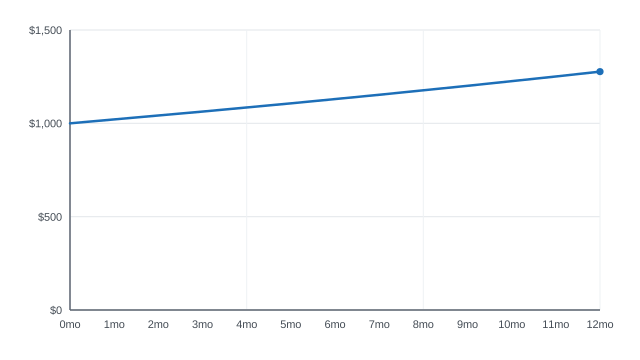
Consider a single balance of $1,000 at 24.99% APR. Nothing changes except time.
Scenario A — carried for 1 month: First-month interest ≈ $20.83 (a rough monthly shortcut; the exact daily figure is close) True cost of that $1,000: roughly $1,021.
Scenario B — carried for 12 months: Because unpaid interest is added to the balance, it accrues daily and compounds across each billing cycle. By the end of twelve months, the total interest paid approaches $277, bringing the true cost of that original $1,000 to roughly $1,277.
Same APR. Same starting balance. A $256 difference in actual dollars spent — simply because of time.
The Formula Behind the Number
Most issuers accrue interest daily, using a daily periodic rate of APR ÷ 365 applied to your average daily balance. Unpaid interest carries into the next cycle, so it compounds over time. A quick way to estimate a single cycle is:
Rough monthly estimate = Balance × (APR ÷ 12)
At 24.99% APR on a $1,000 balance, the shortcut gives about $20.83 for month one — within a few dollars of the exact daily total over a 30–31 day cycle. In month two, interest accrues daily on the new, slightly higher balance — not the original $1,000. That compounding effect is small early on and significant over a year or more.
This is why the roughly half of active U.S. credit card accounts that carry a balance from month to month (Source: CFPB, Consumer Credit Card Market Report, 2025) face a cost that grows quietly and continuously — not because the rate changed, but because time kept passing.
What "True Cost" Actually Means
True cost has a precise definition: the original purchase price plus every dollar of interest allocated to it before it was paid off.
It is not a percentage. It is not an annualized rate. It is a dollar figure — the amount your wallet is actually lighter by the time the balance reaches zero.
A $400 plane ticket carried for eight months at 22% APR does not cost $400. It costs somewhere closer to $450 once interest is included. Whether that difference matters to you is a personal question. But knowing the real number — rather than just the rate — is what makes an informed decision possible. Understanding how interest accumulates invisibly on your statement is the first step toward seeing that number clearly.
Why Percentage Framing Works Against You
There is a reason APR is displayed as a percentage: it is legally required to be, and standardizing the format protects consumers by enabling comparison shopping. But percentages are psychologically abstract. Twenty-five percent sounds manageable in isolation. Two hundred and seventy-seven dollars on a purchase that was already paid for in your mind does not.
People tend to underestimate the cumulative cost of revolving debt when they think in rates rather than dollar amounts. The rate stays constant; the cost grows every month you carry the balance.
For a concrete look at how this plays out across everyday spending categories, the everyday spending hub walks through specific scenarios — coffee, dining, subscriptions — where the gap between purchase price and true cost becomes especially visible. Even credit card rewards carry a hidden cost once a carried balance is part of the picture. This article is focused on the concept itself: understanding why the gap exists at all.
The Number Pay Down Shows You
Pay Down was built around this gap. Rather than surfacing your APR — which your card issuer already discloses — Pay Down shows your true cost in dollars: purchase price plus the interest attributable to it over the time you carried it.
That reframe changes how a balance feels. A 24.99% APR on a $1,000 balance carried for a year is abstract. A $277 interest charge on a purchase you made twelve months ago is concrete.
If you want to see what a specific balance would actually cost at your rate and over your timeline, the True Cost Calculator runs those numbers in real time — no assumptions, just the arithmetic applied to your actual figures.
The Takeaway
APR is not wrong. It is incomplete. It is a rate, which means it needs a balance and a duration before it can produce a cost. Fixating on the rate without knowing the other two variables is like knowing your car's fuel efficiency without knowing how far you are driving.
The number that actually comes out of your bank account is the true cost. That is the figure worth tracking — and one worth tracking consistently, as the difference between rate and cost has a way of compounding into something significant over time.