Avalanche vs. Snowball: Which Debt Payoff Method Is Right for You?
Avalanche vs. Snowball: Which Debt Payoff Method Is Right for You?
Canadians and Americans alike are carrying a heavy credit card load. Total credit card balances reached $1.25 trillion in the first quarter of 2026 (Source: Federal Reserve Bank of New York, Household Debt and Credit Report, Q1 2026), and the average cardholder is paying an APR well above 20% (CFPB Consumer Credit Card Market Report 2025). If you're working to pay that debt down, choosing the right strategy can mean the difference between years of progress and years of spinning your wheels. Before you commit to either method, it's worth a moment to see how a single fixed consolidation loan stacks up against doing it yourself.
Two methods dominate the conversation: the avalanche and the snowball. Here's how they work, how they compare, and how to figure out which one fits you.
How the Avalanche Method Works
The avalanche method prioritises your highest-APR card first, regardless of balance size.
Step by step:
- List all your credit cards from highest APR to lowest.
- Make the minimum payment on every card each month.
- Put all remaining available money toward the highest-APR card.
- Once that card is paid off, roll the entire payment to the next highest-APR card.
- Repeat until all balances are gone.
Because high-APR debt compounds the fastest, attacking it first reduces the total interest you'll pay over time. Mathematically, this is the most efficient path out of debt.
How the Snowball Method Works
The snowball method prioritises your lowest-balance card first, regardless of interest rate.
Step by step:
- List all your credit cards from smallest balance to largest.
- Make the minimum payment on every card each month.
- Put all remaining available money toward the lowest-balance card.
- Once that card is paid off, roll the entire payment to the next smallest balance.
- Repeat until all balances are gone.
The logic here isn't mathematical — it's psychological. Paying off a card completely, even a small one, creates a sense of momentum that can keep you motivated for the longer road ahead.
Side-by-Side Example: Three Cards, Two Strategies
Here's a realistic scenario with three cards and a $400/month total payment budget (minimums included):
| Card | Balance | APR |
|---|---|---|
| Card A | $800 | 29% |
| Card B | $3,200 | 22% |
| Card C | $5,500 | 17% |
Avalanche order: Card A → Card B → Card C Snowball order: Card A → Card B → Card C
In this example, the order happens to be the same — Card A has both the smallest balance and the highest APR. But shift the numbers slightly (say, Card C has a 27% APR instead of 17%), and the strategies diverge. In that version:
- Avalanche targets Card C first, saving hundreds in interest over the life of the debt.
- Snowball still targets Card A first, getting a paid-off account in a matter of months.
The avalanche would save more money. The snowball would deliver a faster win. The "right" choice depends on which outcome matters more to you.
Which Method Saves More Money? Avalanche Wins.
There's no debate on the math. Because the avalanche method eliminates your most expensive debt first, it reduces the total interest that accrues across all your cards. The higher your APRs and the larger your balances, the more meaningful that savings becomes.
With the average APR on credit card accounts assessed interest at 22.15% as of May 2026 (Federal Reserve G.19 Consumer Credit Report, 2026), even a few months of delay in tackling a high-rate balance can add up to significant additional interest charges.
Which Method Do People Actually Stick With? Snowball Has an Edge.
Here's the catch: the best strategy is the one you follow through on. Research suggests that paying off individual accounts — rather than chipping away at balances — produces stronger motivation to keep going (Harvard Business Review, "Research: The Best Strategy for Paying Off Credit Card Debt," 2016). The visible progress of a zeroed-out account can be a more powerful motivator than a slower-moving interest savings number.
And whichever method you pick, having a structured payoff plan at all — rather than paying whatever's left over each month — is what separates steady progress from drift. The strategy itself matters less than having one.
When Does the Snowball Method Actually Make Sense?
The honest answer: when the momentum is worth more to you than the math. To see the actual price tag, picture two cards where the strategies pull in different directions — a small balance at a low rate and a big balance at a high rate. Say Card A has $1,000 at 14% APR and Card B has $6,000 at 24% APR, and you can put $400 a month toward both.
Snowball tells you to knock out Card A first because it's smallest. Avalanche tells you to hit Card B first because it's the expensive one. Run the numbers month by month and both paths get you debt-free in the same 22 months — but they don't cost the same. Snowball pays about $160 more in interest, because it leaves that 24% balance growing while you clear the cheaper card.
Here's the trade you're actually making. Snowball clears a whole account in month 4; avalanche doesn't finish a single card until month 22. That first cleared card — one fewer bill, one visible win — is the entire point of snowball. For some people that early momentum is what keeps them going, and $160 over nearly two years is a fair price for not quitting. For others, the cheapest path out is the only thing that matters. Neither is wrong — but now you know the number.
| Strategy | Total interest | Months to debt-free | First card cleared | Extra interest |
|---|---|---|---|---|
| Snowball | $1,673 | 22 | Month 4 | +$160 |
| Avalanche | $1,513 | 22 | Month 22 | — |
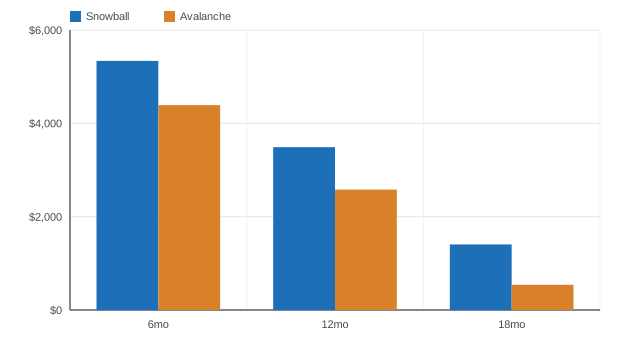
The premium isn't abstract: it's a direct consequence of how long the balance on your 24%-APR card stays alive. Snowball clears that card last, so it keeps accruing interest at the highest rate for nearly two years — the chart below tracks exactly that balance under each method.
It's Not One-Size-Fits-All
A few questions worth asking yourself:
- Do you have one card with a dramatically higher APR? Avalanche likely makes financial sense.
- Do you have a small balance you could pay off quickly? Snowball's early win might be worth a small interest premium.
- Have you tried paying down debt before and quit? Motivation matters — don't underestimate it.
- Are your APRs fairly close together? The interest difference between strategies may be minimal, making snowball's psychological edge more relevant.
Once you've picked a DIY method, there's a bigger fork in the road: whether to combine your debts or simply keep chipping away on your own.
How Pay Down Helps You Decide
Pay Down is a free credit card debt tracking app that takes the guesswork out of this comparison. When you set up a payoff plan, the app shows you your projected debt-free date and total interest for both the Avalanche and Snowball strategies — calculated from your actual balances, APRs, and real payment history.
The Plan tab surfaces a side-by-side comparison so you can see exactly how much interest the Avalanche method saves over Snowball (or whether the difference is negligible). Pay Down flags when the gap is meaningful — $25 or more in interest, or a month or more in payoff time — so you're not guessing whether it matters.
Projections also factor in your average monthly spending per card, so the estimates reflect what you're actually doing, not an idealised scenario.
You can switch between strategies at any time and watch the numbers update instantly. No spreadsheets. No assumptions. Just a clear picture of what each path costs — so you can choose the one you'll actually stick with.