What Is a Balance Transfer Fee — and When Is It Worth Paying?
What Is a Balance Transfer Fee?
When you move existing credit card debt to a new card with a 0% promotional APR, the issuer almost always charges a balance transfer fee — a one-time cost deducted from your available credit at the moment the transfer settles.
The fee is expressed as a percentage of the amount transferred, with a small dollar minimum. As of late 2024, the standard range is 3% to 5% of the transferred balance — 3% is the most common rate, but nearly half of cards now charge 4% or 5% (Source: LendingTree, Balance Transfer Credit Card Report, 2025). On a $6,000 balance, that means paying $180 to $300 upfront — before you've made a single payment.
The core question this article answers: is that fee worth paying? The answer depends entirely on how much interest you would have paid otherwise.
How Does a Balance Transfer Fee Work in Practice?
The mechanics are straightforward:
- You apply for a card offering a 0% intro APR on balance transfers.
- You request a transfer of your existing balance (or part of it).
- The issuer charges the fee — typically 3% or 5% — and adds it to your new balance.
- You pay no interest during the promotional window (commonly 12–21 months) if you meet the card's terms.
So a $5,000 transfer with a 5% fee arrives on the new card as a $5,250 balance. You owe more than you started with — the bet is that the interest you avoid on the original card more than compensates for that extra $250.
For a fuller overview of how balance transfers are structured, see this guide to balance transfers and when they save money.
What Is the Break-Even Formula?
The break-even point is the moment at which interest avoided equals the fee paid. Everything after that point is net savings.
The Core Formula
Interest Avoided = Balance × (APR ÷ 12) × Promo Months
Fee Paid        = Balance × Fee Rate

Net Savings     = Interest Avoided − Fee Paid
Break-Even (months) = Fee Rate ÷ (APR ÷ 12)
Plugging in the break-even month formula:
- 3% fee / 20% APR: Break-even at 1.8 months
- 5% fee / 20% APR: Break-even at 3.0 months
- 5% fee / 15% APR: Break-even at 4.0 months
In plain terms: if your promo window is 12–21 months and your current APR is in the typical range, you reach break-even well before the promo expires — as long as you're actually carrying a balance (i.e., you're not paying it off in full each month anyway).
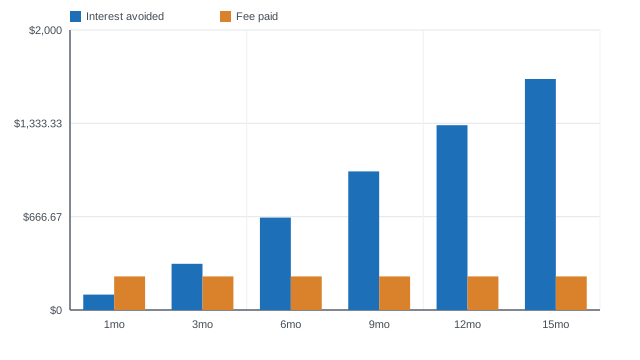
Worked Example: $6,000 Balance, 22% APR, 15-Month Promo
This is a realistic scenario. The average APR on credit card accounts actually assessed interest was 22.15% as of May 2026 (Source: Federal Reserve Board, Consumer Credit - G.19, 2026), and 15-month promotional windows are among the most common offers available.
| Item | Calculation | Amount |
|---|---|---|
| Balance transferred | — | $6,000 |
| Balance transfer fee (4%) | $6,000 × 0.04 | $240 |
| Monthly interest rate | 22% ÷ 12 | 1.833% |
| Interest over 15 months (approx., simple) | $6,000 × 1.833% × 15 | $1,650 |
| Net savings after fee | $1,650 − $240 | $1,410 |
| Break-even month | 4% ÷ 1.833% | Month 2.2 |
Key takeaway: In this scenario, you're ahead of the fee within the third billing cycle. Over the full 15-month window, the transfer saves roughly $1,410 net.
Note: this uses a simplified interest estimate. Real interest accrues on a declining balance as you make payments — actual savings will vary, but the directional conclusion holds strongly.
How Does APR Affect Whether the Fee Is Worth It?
The higher your current APR, the faster the fee pays for itself. The table below shows net savings across three common balances and APR levels for a 5% fee and a 15-month window.
| Balance | Current APR | Fee (5%) | Est. Interest Avoided | Net Savings |
|---|---|---|---|---|
| $3,000 | 18% | $150 | $675 | $525 |
| $3,000 | 24% | $150 | $900 | $750 |
| $6,000 | 18% | $300 | $1,350 | $1,050 |
| $6,000 | 24% | $300 | $1,800 | $1,500 |
| $10,000 | 22% | $500 | $2,750 | $2,250 |
Even at the highest fee rate (5%), a balance of $3,000 or more at a typical current APR generates meaningful net savings over a standard promo window.
When Is a Balance Transfer Fee Worth Paying?
A balance transfer fee is likely worth paying when all of the following are true:
- Your current APR is above ~15%. Below that threshold, savings thin out, especially against a 5% fee.
- You have enough balance to make the math meaningful. Transferring $500 to save $40 in interest is rarely worth the administrative effort, even if the fee is low.
- The promo window is long enough relative to your balance. If you can realistically pay off the transferred balance during the promo period, you lock in the full savings.
- You won't add new purchases to the new card. New purchases on a balance transfer card may accrue interest immediately at the regular APR, which can erode savings (Source: CFPB, Do I pay interest on new purchases after a balance transfer?).
- You have a plan to Pay Down the balance. The fee is a sunk cost — if the balance lingers past the promo window, you'll owe regular interest on whatever remains. For what happens when the promotional period ends, read more about what comes after the 0% window closes.
When Is a Balance Transfer Fee NOT Worth Paying?
The fee works against you in these situations:
- Your current APR is already low — for example, a card you qualified for during a period of low rates or with an existing promotional rate of your own.
- You're close to paying off the balance anyway. If the debt would be gone in two or three months, the interest avoided is minimal and the fee likely exceeds it.
- The promo window is very short (6 months or fewer). Less runway means the fee has less interest to offset.
- The transfer fee is unusually high (some cards charge 5% with no cap and a high minimum). Always read the Schumer Box before you apply.
- You're evaluating a range of debt tools and a personal loan might offer a lower effective cost. If you're weighing a balance transfer against a consolidation loan as distinct financial instruments, that comparison is covered separately — see balance transfer vs. consolidation loan.
Does Balance Size Change the Math?
Yes — but not in the way people assume. The fee is proportional to the balance, and so is the interest saved. What actually changes the break-even equation is the relationship between the fee rate and the monthly interest rate, not the balance size itself.
What balance does affect is whether the savings are worth the effort and credit inquiry. As a practical rule of thumb, a balance of around $1,000 is where a transfer starts to justify the paperwork and the hard inquiry — and the financial benefit compounds quickly as balances grow into the $3,000–$10,000 range.
Are There No-Fee Balance Transfer Cards?
Some issuers periodically offer 0% promo cards with no balance transfer fee. These are rare — only about 4% of balance transfer cards charged no fee as of late 2024 (Source: LendingTree, Balance Transfer Credit Card Report, 2025) — and they often come with tradeoffs such as shorter promo windows or membership requirements.
If you find one, the break-even point is immediate — any interest avoided is pure savings. The tradeoff is usually a shorter promo window or stricter credit requirements.
Quick Reference: Worth It or Not?
| Scenario | Fee Worth Paying? |
|---|---|
| $5000 balance, 22% APR, 18-month promo, 5% fee | ✅ Yes — large net savings |
| $800 balance, 17% APR, 12-month promo, 5% fee | ⚠️ Yes, but marginal — nets ~$96; on a balance this small, weigh the effort and hard inquiry |
| $3000 balance, 25% APR, 15-month promo, 3% fee | ✅ Yes — break-even in under 2 months |
| $2000 balance, 13% APR, 6-month promo, 5% fee | ❌ Not worth it — only ~$30 ahead in the best case; pay the balance down during the promo and even that disappears |
| $10000 balance, 22% APR, 21-month promo, 4% fee | ✅ Yes — substantial net savings |
Run the Numbers for Your Balance
The worked examples above use simplified interest math. Your actual savings depend on your real balance, the exact APR on your current card, the fee rate on the new card, and how much you pay each month during the promo window.
Run your specific numbers through the Pay Down balance transfer calculator to see your personalised break-even month and estimated net savings before you apply.