How the Credit Card Grace Period Works (and How to Pay Zero Interest)
How Does the Credit Card Grace Period Work — and How Do People Pay Zero Interest?
The grace period is the window between your statement closing date and your payment due date — typically 21 to 25 days. Pay the full statement balance by the due date every cycle, and new purchases never accrue interest at all.
That one sentence describes how tens of millions of cardholders use credit cards as an interest-free float. The rest of this guide explains exactly how the mechanics work, what it takes to keep that window intact, and what happens the moment it disappears.
What Is a Credit Card Grace Period?
A grace period is the legally mandated minimum gap between the day your issuer delivers (or makes available) your monthly statement and your payment due date. Federal law — specifically the CARD Act of 2009 — requires at least 21 days between statement delivery and the due date, giving cardholders time to review their statement and pay without incurring interest. Many issuers offer 25 days or more, but 21 days is the floor.
The grace period does not begin on your purchase date or even your statement closing date in isolation. The clock starts when your billing cycle closes and your statement is generated. Your due date is set a fixed number of days after that closing date, and the gap between the two is your grace window.
Verified figures: The average APR on interest-assessed accounts is 22.15% (Federal Reserve G.19, May 2026). According to Bankrate's 2026 data, 47% of cardholders carry a balance month to month — meaning more than half of cardholders have the potential to benefit from a grace period every single cycle.
The Three Modes of Grace
Grace is not simply "on" or "off" — it exists in three distinct states. Understanding which mode your account is in determines whether your next purchase is free money or an immediate interest charge.
Mode 1 — Grace Intact
Your grace period is intact when your previous statement balance was paid in full (or closed at zero) and no interest was charged that cycle. In this state, any new purchases made during the current billing cycle are completely free of interest — they simply wait on the account. If you pay the new statement balance in full before its due date, those purchases cost exactly what the price tag said. Not a penny more.
This is the default state for cardholders who pay in full every cycle.
Mode 2 — Grace at Risk
Your grace is at risk when your current statement has closed with a balance and the due date has not yet passed. You are still holding the full grace period right now — but only until the due date. If you pay the complete statement balance by that date, grace snaps back to intact and new purchases remain interest-free. If you pay anything less — even one dollar short — grace is lost for the next cycle.
Many cardholders live in this zone every month without realizing it. The due date is not a soft deadline; it is the boundary between zero interest and significant interest.
Mode 3 — Grace Lost
Grace is lost the moment the due date passes without payment of the full statement balance. Carrying even $1 of unpaid balance has two immediate consequences:
- Retroactive interest: Interest does not begin accruing from the due date forward. Depending on how your issuer handles the cycle, purchases may accrue interest from the day they posted.
- No grace on new purchases: New purchases begin accruing interest from the day they post — there is no free window at all.
This second point is often the most surprising. A cardholder who carries a balance may assume their new purchases are still protected. They are not. To understand exactly how a carried balance makes even brand-new charges accrue interest immediately, see this explanation of how prior-balance interest affects new purchases.
What Exactly Must Be Paid to Keep Grace?
You must pay the statement balance — the balance shown on the closed statement — by the due date. Not the current balance, not a partial payment, not just the minimum payment. One dollar short costs you grace. One day late costs you grace.
The difference between your statement balance and your current balance is meaningful and worth understanding on its own, but the rule for grace is simple: the number printed on your statement as the closing balance is the target.
How Interest Actually Accrues When Grace Is Lost
Credit card interest is not calculated monthly. It accrues daily. The daily periodic rate is APR ÷ 365, and it is applied to your average daily balance — the average of what you owed on each calendar day of the billing cycle. For a deeper look at the full mechanics, this guide on how credit card interest is actually calculated walks through the math step by step.
At 22.15% APR, the daily rate is approximately 0.0607%. On a $1,000 balance, that is about $0.61 per day — small on day one, but relentless across 30 days.
To see how daily accrual adds up on your specific balance and APR, the Pay Down average daily balance calculator lets you run your own numbers.
Worked Example: The Same $1,000 Purchase, Two Outcomes
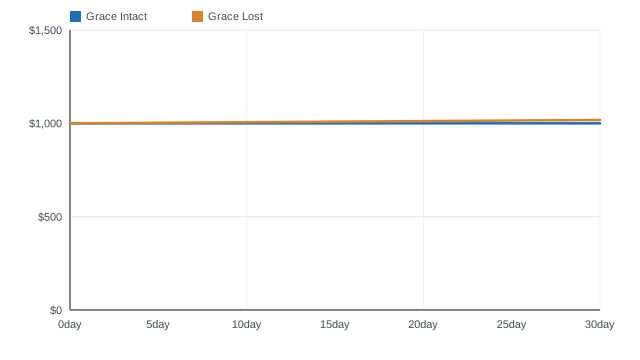
The model below uses a simplified approximation: monthly interest = APR ÷ 12 × balance, stated explicitly as a rough illustration.
| Scenario | Purchase Amount | Grace Status | Interest Charged | Total Cost |
|---|---|---|---|---|
| Grace Intact — paid in full by due date | $1,000 | Intact | $0.00 | $1,000.00 |
| Grace Lost — balance carried 30 days at 22.15% APR | $1,000 | Lost | ~$18.46* | ~$1,018.46 |
Approximation using APR ÷ 12 × balance ($1,000 × 0.2215 ÷ 12 ≈ $18.46). Actual interest uses the daily rate (22.15% ÷ 365 ≈ 0.0607%) applied to the average daily balance across the cycle and will vary by issuer and cycle length.
The cost difference on a single $1,000 purchase for a single month is modest. But at an average balance of $6,730 (Experian, Q3 2024) carried month after month, the daily meter compounds the gap substantially.
Where Does the Grace Period Come From? (The Legal Foundation)
The CARD Act of 2009 established the minimum 21-day requirement. Before that law, some issuers shortened grace periods or moved due dates without notice, catching cardholders off guard. The law standardized the minimum and required issuers to keep due dates consistent — typically the same calendar date each month.
That said, the law sets a floor, not a ceiling. Issuers can offer longer grace periods, and many do. Some accounts — particularly deferred-interest promotions — operate under different rules entirely and may not have a traditional grace period.
Important Caveats: Grace Varies by Issuer
No two issuers handle every edge case identically. The following details can differ from bank to bank:
- Grace period length — 21 days is the legal minimum; many issuers offer 25 days or more.
- Trailing interest — After paying off a carried balance, you may owe a small amount of residual interest on the next statement, even though you thought the account was clear.
- Cycle-boundary purchases — Purchases made near your closing date may post to the new cycle rather than the current one, affecting when their grace period ends.
- Cash advances and balance transfers — These typically have no grace period at all and begin accruing interest from the transaction date.
The only authoritative source for your specific account's rules is your cardholder agreement. The Consumer Financial Protection Bureau's CFPB Regulation Z 6(b)(2)(v) Grace Period explains what issuers are and are not required to disclose.
Key Takeaways
- The grace period is the gap between your statement closing date and your due date — at least 21 days by law, often 25 or more.
- Grace has three states: intact (last balance paid in full), at-risk (balance unpaid but due date not yet passed), and lost (due date passed without full payment).
- Paying the full statement balance by the due date is the only action that keeps grace; paying one dollar short or one day late eliminates it entirely.
- When grace is lost, carrying even $1 means interest accrues on your entire average daily balance — not just the unpaid dollar — and new purchases begin accruing interest from the day they post.
- Interest accrues daily at APR ÷ 365, not monthly; the mechanism is the daily rate applied to the average daily balance across the cycle.
- Grace rules for cash advances, balance transfers, and promotional offers differ — check your cardholder agreement for the specifics that apply to your account.
How Pay Down tracks your grace period for you
Everything this guide walks through by hand, the Pay Down app tracks for you. The free app shows which of your cards are interest-free right now and can remind you before a grace period ends — anchored to your card's actual statement closing and due dates, not a guess.
Premium goes further: the Insights tab carries the full grace-state view for every card — intact, at-risk, or lost, the same three modes explained above — alongside bank auto-sync through Plaid to keep statements current and an effective-APR trend that shows what lost grace actually costs. And when you want to see what one specific purchase really cost after lost-grace interest, the True Cost calculator breaks it down.
Pay Down is free on the App Store and Google Play.