How Credit Utilisation Affects Your Credit Score
What Is Credit Utilisation?
Credit utilisation is the percentage of your available revolving credit that you're currently using. The formula is simple:
Credit Utilisation = Balance ÷ Credit Limit × 100
For example, a $2,000 balance on a card with a $5,000 limit gives you a utilisation rate of 40% on that card.
Lenders and credit bureaus treat this number as a signal of financial stress. The higher your utilisation, the more it can suggest you're leaning heavily on borrowed money — even if you pay your bill in full every month.
Why Does Utilisation Account for ~30% of Your FICO Score?
FICO scores are built from five categories. Payment history is the largest slice at 35%, but amounts owed — which includes utilisation — comes in second at approximately 30% (Source: FICO Score, Education, 2024).
That makes utilisation the second most influential factor in your score, ahead of the length of your credit history, your credit mix, and new enquiries.
The reasoning is grounded in decades of default-prediction research. Borrowers who consistently use a large share of their available credit are statistically more likely to miss payments or default (Source: myFICO, Amounts Owed). Keeping utilisation low signals that you have credit available but don't depend on it.
What Threshold Should You Aim For?
The widely cited guidance is to keep utilisation below 30% across all cards and on each individual card. But scoring models reward lower utilisation even more generously. Among consumers with FICO scores of 800, the average utilisation rate is just 7.7% — comfortably in the single digits (Source: Experian, 800 Credit Score).
A practical two-tier target:
- Below 30% — generally considered the floor for protecting your score
- Below 10% — associated with the strongest score outcomes in the "amounts owed" category
Neither threshold is a hard cliff. Scores shift on a continuum, but the difference between 5% and 35% utilisation on the same card can meaningfully move your score.
How Is Utilisation Calculated — Per Card and Overall?
FICO scoring models look at utilisation in two ways simultaneously:
Per-card utilisation — Each individual card's balance is measured against its own limit. A maxed-out card hurts your score even if your overall utilisation looks healthy.
Overall (aggregate) utilisation — All balances across all revolving accounts are added together and divided by the sum of all limits.
| Card | Balance | Limit | Per-Card Utilisation |
|---|---|---|---|
| Card A | $2,000 | $5,000 | 40% |
| Card B | $500 | $4,000 | 12.5% |
| Card C | $0 | $3,000 | 0% |
| Total | $2,500 | $12,000 | 20.8% |
In this example, your aggregate utilisation is a reasonable 20.8% — but Card A at 40% is still pulling your score down on its own.
A Concrete Example: The $2,000 Balance on a $5,000 Limit Card
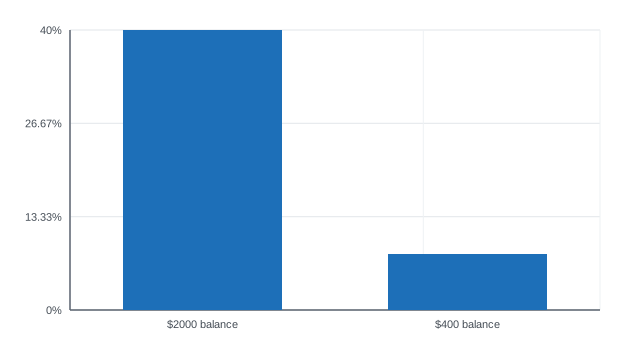
Say you carry a $2,000 balance on a single card with a $5,000 credit limit. Your per-card utilisation is 40%.
That single card is already above the commonly recommended 30% threshold. If this is your only card, your overall utilisation is also 40%.
Now consider two scenarios:
- You pay the balance down to $400. Utilisation drops to 8% — well below the 10% "ideal" tier.
- You request a credit limit increase to $10,000 (without adding new debt). Utilisation drops to 20% using the same $2,000 balance.
Both moves reduce the number that credit scoring models see — though paying down the balance is the more direct approach because it also reduces your actual debt load.
Why Utilisation Changes Month to Month
Your utilisation isn't a fixed number — it updates every billing cycle. Credit card issuers typically report your balance to the bureaus on or just after your statement closing date, not your payment due date (Source: Experian, When Do Credit Card Payments Get Reported?).
This means even if you pay in full each month, a large purchase made mid-cycle can show up as a high balance on your credit report before you've had a chance to pay it. Timing matters: paying down a balance before the statement closes can lower the figure that actually gets reported.
High utilisation usually means a carried balance — and carrying a balance has costs beyond your credit score. The Minimum Payment Calculator shows how long your current payment keeps your balance — and your utilisation — elevated. And if high utilisation is spread across several cards, our debt consolidation guide covers how moving revolving balances to an installment loan changes the picture.
How Pay Down Helps You Track Utilisation
Understanding utilisation in theory is one thing — keeping track of it across multiple cards in real life is another.
Pay Down is a free app designed specifically for credit card debt. It shows your current balance on every card and sorts each one into a utilisation tier — Ideal (under 10%), Good (10–30%), Caution (30–50%), or High (50% and up) — along with how much you'd need to pay down to reach the next tier. It also tracks your overall utilisation, the figure lenders weigh most heavily, recalculating it across your cards as your balances change.
Rather than manually dividing balances by limits across five or six cards, Pay Down gives you a single dashboard view — so you can see at a glance which cards are nudging into high-utilisation territory and how much a payment would move each one toward a lower tier. For anyone managing multiple cards, that visibility makes it much easier to act with your credit score in mind.