How a $5 Daily Habit Really Costs You When You Carry a Balance
The Short Answer: How Much Does a Daily $5 Habit Really Cost?
A $5 daily purchase charged to a card carrying a balance does not cost $5. Over a year, those purchases add roughly $1,825 in new principal, and at a typical APR of 21–22%, the interest allocated to just that habit can push the true annual cost well above $2,000 — sometimes closer to $2,200 or more, depending on how long the balance is carried.
The core mechanic is simple: when you do not pay your full statement balance each month, every new charge begins accruing interest from the moment it posts. A small, repeated purchase does not stay small — it multiplies.
Why Small Daily Charges Are Different From One-Off Purchases
A single $5 charge is easy to rationalize. The problem is that a daily habit is not one charge — it is approximately 365 charges per year, each one joining the revolving balance and each one accruing interest for as long as the balance remains unpaid.
This compounding effect is what separates recurring daily spend from a one-time purchase. With a one-off charge, the interest clock runs on a fixed principal amount. With a daily habit, new principal is added every single day, which continuously expands the interest-accruing base.
This same mechanic applies to the carried-balance multiplier behind all everyday spending — daily habits simply make that multiplier visible because the charges are relentless and predictable.
What Counts as a "Small Daily Habit"?
For this analysis, the scope is any recurring sub-$15 purchase repeated daily or near-daily:
- Lunch or a quick-service meal — $8–$12 per day
- Vending machine snacks or drinks — $2–$5 per day
- Convenience store stops — $4–$10 per day
- Short rideshare or transit app charges — $5–$14 per day
- Daily coffee stop — $4–$7 per day (for the coffee-specific breakdown, see the detailed coffee habit analysis)
Each of these is a separate transaction charged to the card, and each one adds to the revolving principal if you carry a balance.
How Credit Card Interest Is Calculated on Daily Purchases
Most credit cards use the average daily balance method. The issuer adds up your balance for each day of the billing cycle, divides by the number of days, then multiplies by the daily periodic rate (APR ÷ 365).
When you add a new charge every day, your average daily balance rises continuously through the cycle. By the end of the month, the interest charge is not calculated on just the opening balance — it reflects every new purchase added during that period.
The average APR on credit card accounts assessed interest stands at 22.15% as of May 2026 (Source: Federal Reserve Board, Consumer Credit - G.19, 2026). At that rate, the daily periodic rate is approximately 0.0607% — applied to a balance that grows every time you tap your card.
Worked Example: The True Annual Cost of a $5 Daily Habit
Assumptions:
- Daily charge: $5
- Days per year: 365
- APR: 21.76% (illustrative — close to the Federal Reserve's current average on accounts assessed interest)
- Daily periodic rate: 21.76% ÷ 365 = 0.05962%
- Balance carried: the full year (minimum payments made, but balance not fully paid off)
Step 1 — Total New Principal Added
$$5 \times 365 = $1{,}825 \text{ in new purchases per year}$$
Step 2 — Average Days Each Dollar Is Carried
Charges added daily across 365 days are carried for an average of approximately 183 days before the year ends.
Step 3 — Interest Allocated to This Habit
Using simple interest as an approximation:
$$$1{,}825 \times 21.76% \times \frac{183}{365} \approx $199$$
Add that to the principal:
$$$1{,}825 + $199 = \approx $2{,}024 \text{ true annual cost}$$
The $5 habit costs roughly $2,024 per year — about $199 more than the sticker price — purely in interest allocation.
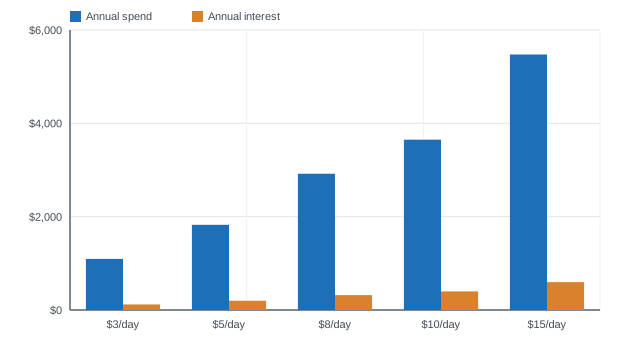
The figure grows materially as the daily spend increases:
How the Habit Compounds Over Multiple Years
The example above covers one year. In practice, many cardholders carry balances for two or more years. The average U.S. consumer carries a credit card balance of $6,730 (Source: Experian, State of Credit Cards, 2024) — a level at which balances typically persist long enough for multi-year compounding to apply.
When the $5 daily habit is carried for 24 months with no payments made, the interest allocation more than doubles because:
- The habit adds another $1,825 in year two
- The interest from year one that was not paid off begins accruing its own interest
- The bigger the balance grows, the higher the minimum payment an issuer would require — yet that rising floor climbs more slowly than the balance itself
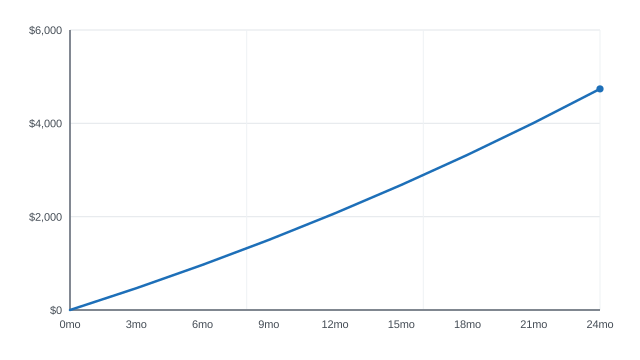
Making only the minimum payment slows this curve but does not reverse it: as long as the daily habit keeps adding new charges, the balance keeps climbing.
Why Minimum Payments Do Not Contain This Habit
The minimum payment on most cards is 1–2% of the outstanding balance or a flat dollar floor — whichever is greater (Source: CFPB, Consumer Credit Card Market Report, 2023). When a daily habit continuously adds new principal, the minimum payment is a moving target that almost never exceeds the new charges being added.
Key effect: The minimum payment primarily services interest, not principal. A cardholder making only minimum payments on a $5,000 balance at 20% APR could take more than 17 years to pay it off and pay more in interest than the original balance — the pattern behind the CFPB's finding that a growing share of accounts revolve at minimum payments (Source: CFPB, Consumer Credit Card Market Report, 2023).
A daily habit that keeps adding to that balance makes the payoff horizon longer, not shorter.
How to Quantify Your Own Daily Habit
The worked example above uses $5 and the Federal Reserve's average APR — your real numbers will differ. The relevant inputs are:
- Your daily spend amount (receipt average or app transaction history)
- Your card's APR (found on your statement or issuer portal)
- How long you realistically carry the balance (months or years)
Plugging those figures into the True Cost calculator will show you the interest allocated specifically to that habit, at your actual rate.
Practical Framing: What the Interest Buys You
The ~$199 in annual interest from a $5 daily habit is not spent on the habit itself — it is spent on nothing. It purchases no lunch, no snack, no ride. It is purely the cost of the financing arrangement.
Stated differently: every $5 daily habit on a carried balance has a silent co-cost of roughly $0.55 per day in interest at the average APR. A $10 daily habit doubles that. The charge you see on the receipt is not the charge you ultimately pay.
Key Takeaways
- A $5 daily charge adds $1,825 in new principal per year — before interest.
- At the worked example's 21.76% APR — just under the Federal Reserve's current 22.15% average for accounts assessed interest (Source: Federal Reserve Board, Consumer Credit - G.19, 2026) — approximately $199 in interest is allocated to that habit annually.
- Multi-year carrying roughly doubles and then triples the true cost as interest compounds on interest.
- Minimum payments do not offset continuous new daily charges; balances grow even when the minimum is paid on time.
- Sub-$15 daily habits — lunch, vending runs, convenience stops, rideshares — all follow the same math; only the daily dollar amount changes.
- Use the True Cost calculator to price your specific habit at your actual APR.