Dollar-Days and FIFO: The Math That Decides What Each Purchase Really Costs
Dollar-Days and FIFO: The Maths That Decides What Each Purchase Really Costs
Most credit card statements show a single interest charge at the bottom of the page. One number, one line. But that charge is the product of two distinct mathematical systems working simultaneously — one that determines how your payments reduce your balance, and one that allocates interest costs back to individual purchases. FIFO payment allocation routes your dollars to specific balance tiers based on APR; dollar-days interest weighting determines what share of the monthly interest charge each individual purchase actually caused. Understanding both systems changes how you read every statement you will ever receive.
In the example below, a $10.98 interest charge gets divided so groceries absorb 32.9%, electronics 63.1%, and dining just 4.0% — not because of their price tags, but because of how long each balance sat unpaid.
FIFO Payment Allocation: Where Your Money Goes First
When you make a credit card payment, you probably assume it chips away at your balance in some reasonable, neutral way. The reality is more structured — and more consequential.
Under rules established by the Credit Card Accountability Responsibility and Disclosure Act of 2009 (CARD Act), any amount you pay above the minimum must go to the highest-APR balance first. The minimum payment itself is left to the issuer's discretion — and in practice, issuers typically apply it to the lowest-APR balance. (Source: Regulation Z, 12 CFR § 1026.53, Payment Allocation)
This is known as FIFO payment allocation — First In, First Out — though in credit card terms it is more accurately a tiered-rate system than a strict chronological queue. Here is why it matters in practice.
A Real-World Scenario
Suppose your card carries three balance types simultaneously:
- $1,200 in standard purchases at 19.99% APR
- $400 in a promotional balance transfer at 0% APR (for 12 months)
- $300 in cash advances at 29.99% APR
Your minimum payment might be $50. The law leaves the minimum to your issuer's discretion, and issuers typically apply it to the lowest-APR balance — so that $50 goes to the 0% balance transfer first. Your 29.99% cash advance sits untouched, accruing interest daily.
Now suppose you pay $200 that month. The minimum ($50) still goes to the 0% balance. The remaining $150 above the minimum goes to the cash advance balance at 29.99% — the highest APR. The standard purchase balance at 19.99% gets nothing until both ends of the spectrum are resolved.
This framework was designed to protect consumers from the pre-CARD Act era, when issuers could route all payments to low-APR balances and allow high-APR debt to compound indefinitely. The current rule is an improvement, but it still rewards cardholders who pay significantly above the minimum. Paying only the minimum leaves high-APR balances largely intact.
The practical takeaway: if you carry mixed balance types, the size of your payment — not just the fact that you made one — determines which debt actually shrinks.
Dollar-Days Interest Weighting: Allocating Interest to Each Purchase
FIFO determines payment flow. A separate calculation determines how to assign the monthly interest charge back to individual purchases. This is where dollar-days interest allocation enters.
The Average Daily Balance Foundation
Credit card interest is calculated on the average daily balance method. Your issuer tracks your balance every single day of the billing cycle, sums those daily balances, and divides by the number of days in the cycle. That average is then multiplied by the daily periodic rate (your APR ÷ 365) and the number of days in the cycle. (Source: CFPB, How Does My Credit Card Company Calculate the Amount of Interest I Owe?)
But average daily balance gives you a single interest figure for the whole card. Dollar-days weighting answers the next question: how much of that interest charge belongs to each individual purchase?
The Dollar-Days Formula
A purchase's share of monthly interest equals:
(Purchase Balance × Days Carried) ÷ (Sum of All [Purchase Balance × Days Carried])
In other words, each purchase is weighted by both its size and how long it sat on your card during the cycle. A large purchase posted on day one of the cycle generates far more dollar-days than a small purchase posted on day twenty-eight.
A Step-by-Step Numerical Example
Let us make this concrete with a 30-day billing cycle and three purchases posted on different days. Assume a single APR of 22% and a carried balance (no payment made).
| Purchase | Amount | Posted Day | Days Carried |
|---|---|---|---|
| Groceries | $200 | Day 1 | 30 |
| Electronics | $500 | Day 8 | 23 |
| Dining | $80 | Day 22 | 9 |
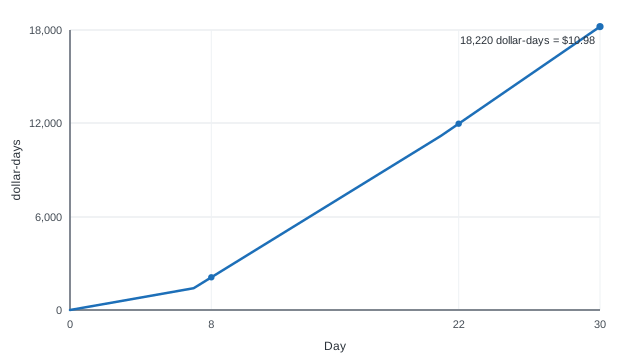
Step 1: Calculate dollar-days for each purchase.
- Groceries: $200 × 30 = 6,000
- Electronics: $500 × 23 = 11,500
- Dining: $80 × 9 = 720
- Total dollar-days: 18,220
Step 2: Calculate each purchase's weight.
- Groceries: 6,000 ÷ 18,220 = 32.9%
- Electronics: 11,500 ÷ 18,220 = 63.1%
- Dining: 720 ÷ 18,220 = 4.0%
Step 3: Calculate total interest for the cycle.
Average daily balance = (6,000 + 11,500 + 720) ÷ 30 = $607.33
Daily periodic rate = 22% ÷ 365 = 0.06027%
Monthly interest = $607.33 × 0.06027% × 30 = $10.98
Step 4: Allocate interest to each purchase.
- Groceries: $10.98 × 32.9% = $3.61
- Electronics: $10.98 × 63.1% = $6.93
- Dining: $10.98 × 4.0% = $0.44
Notice that the $80 dining charge contributes only $0.44 in interest — not because it is small, but because it was posted late in the cycle and barely had time to accumulate dollar-days. The $200 grocery purchase, despite being smaller than the electronics purchase, generates more interest than its face value might suggest, simply because it sat on the card for the full 30 days.
Why This Method Is the Fairest Allocation
Dollar-days weighting is fair in a precise mathematical sense: it respects both dimensions of borrowing: how much you borrowed and how long you borrowed it. A simple proportional split by purchase amount would overcharge late-cycle purchases and undercharge early ones. Allocating equally across purchases regardless of size or timing would be even more distorted. Dollar-days captures the actual economic cost each purchase imposed on your credit line during the cycle.
How Pay Down Uses This Maths
This is precisely the calculation behind Pay Down's True Cost Calculator. When you view a purchase in the app, Pay Down applies dollar-days weighting to show the estimated interest allocated to that specific transaction over the time it is carried — an estimate built on the same average daily balance maths your issuer uses to generate that single line on your statement, extended to show each purchase's share.
A $500 electronics purchase carried for eight months at 22% APR does not cost $500. Dollar-days maths makes that gap visible and specific. The True Cost Calculator is available to all Pay Down users at no cost, and the figures it generates are informational estimates designed to help you understand the real weight of carried balances.
For users who want to go deeper, the Insights tab — a premium feature — includes the Debt-Free Trajectory, Velocity Score, Months Carried Distribution, and ten additional analyses that build on this same foundation to show patterns across your entire debt picture.
The Bottom Line
Your credit card statement is the output of two simultaneous systems: FIFO payment allocation, which routes your pounds to specific balance tiers based on APR, and dollar-days interest weighting, which determines what portion of the monthly interest charge each purchase genuinely caused. Neither system is arbitrary — both follow defined mathematical logic. Once you understand that logic, the numbers on your statement stop being opaque and start being legible.
And legible numbers are the first step towards controlling them.
This allocation logic has a surprising consequence in practice: why a fresh purchase sitting on top of an old balance can carry a heavier charge.
To see this in action, you can run the day-by-day numbers for your own billing cycle and watch how each day adds up.