How to Read Your Credit Card Statement (And What the Bank Won't Explain)
How to Read Your Credit Card Statement (And What the Bank Won't Explain)
Quick answer: A credit card statement is divided into roughly eight labelled sections. Each one tells you something specific about what happened to your balance during the billing cycle. The most important — and least explained — are the interest charge line and the interest charge calculation box, which together reveal exactly how the bank computed what you owe in interest. This article walks through every line, tells you what it means, and shows you where to look for the numbers that matter.
Why Statements Are Harder to Read Than They Should Be
The average American consumer carries $6,730 in credit card debt as of the third quarter of 2024 (Experian State of Credit Report). Despite that, most cardholders have never fully decoded a statement. Issuers are required by the CARD Act of 2009 to disclose specific information — but they are under no obligation to explain it clearly (Source: CFPB, Consumer Credit Card Market Report, 2023).
The result: a document full of labelled boxes that mean more than they appear to.
What Does Each Section of a Credit Card Statement Mean?
The table below maps every standard statement line to a plain-English definition and a reason it matters to your balance.
| Statement Line | What It Means | Why It Matters |
|---|---|---|
| Previous Balance | The balance you carried into this billing cycle | The starting point for your average daily balance calculation |
| Purchases | All new charges posted during the cycle | Increases your balance; each purchase has its own transaction date |
| Payments & Credits | Payments received plus any refunds or statement credits | Reduces your balance; timing affects your average daily balance |
| Fees Charged | Late fees, over-limit fees, annual fees, or balance-transfer fees | Added to your balance and may themselves accrue interest |
| Interest Charged | The dollar amount of interest the bank assessed this cycle | The bottom-line cost of carrying a balance |
| New Balance | Previous balance + purchases + fees + interest − payments | What you actually owe as of the statement closing date |
| Minimum Payment Due | The smallest amount accepted without a late fee | Paying only this extends payoff time significantly and costs far more in interest |
| Payment Due Date | The deadline for your payment to be received | Missing it triggers a late fee and can trigger a penalty APR |
| APR / Interest Rate | Your annual percentage rate for each balance category | Determines how fast interest accumulates between statements |
| Interest Charge Calculation Box | Shows your average daily balance, daily periodic rate, and how the charge was computed | The only place on the statement where the bank shows its work |
Walking Through Each Line
What Is the Previous Balance?
The previous balance is whatever remained on your account when last month's statement closed. It is not the amount you owed at the moment you make a payment — it is a snapshot taken at a specific date.
If you paid in full last cycle, this line should read $0 and you likely owe no interest this cycle (assuming your card has a grace period). If any balance carried over, it has been accruing interest since the day after the last statement closed.
What Are Purchases?
This section lists new charges — retail transactions, online orders, subscription renewals — that posted before the statement closing date. Charges that posted after the closing date appear on next month's statement.
Each purchase has its own transaction date, which matters because interest is allocated across individual charges differently depending on how long each one sat on the account. The total shown here feeds directly into your average daily balance.
What Do Payments and Credits Mean?
This line totals every payment the bank received during the cycle, plus any merchant refunds or promotional credits. A critical detail: the timing of your payment changes your interest charge, not just the amount.
A $500 payment made on day 5 of a 30-day cycle reduces the balance for the remaining 25 days. The same payment made on day 25 only reduces it for 5 days. That difference shows up in next month's interest charged line.
What Are Fees Charged?
Fees are itemised here — late fees (typically $30–$32 for a first occurrence under Regulation Z safe-harbor limits), annual fees, balance-transfer fees, and cash-advance fees (Source: CFPB, Consumer Credit Card Market Report, 2023). These are added to your balance and, unless you pay them off, they accrue interest at the standard purchase APR.
What Is the Interest Charged Line?
This is the dollar figure the bank assessed for carrying a balance. It is calculated using your average daily balance — the mean of your account balance for each day in the billing cycle — multiplied by the daily periodic rate and the number of days in the cycle.
This single number is the most important line on the statement because it represents the real, out-of-pocket cost of your balance. For the full derivation of how that number is reached, the how credit card interest is calculated pillar article covers the mechanics in detail.
What Is the New Balance?
The new balance is the arithmetic result of the cycle:
New Balance = Previous Balance + Purchases + Fees + Interest Charged − Payments & Credits
This is what you owe on the statement closing date. It is not what you will owe in 30 days if you make no payment — interest will continue to accrue daily from the closing date forward.
What Is the Minimum Payment Due?
The CARD Act requires issuers to calculate a minimum that pays down principal, not just interest. In practice, minimums are often set at 1–2% of the outstanding balance or $25, whichever is greater (Source: CFPB, Consumer Credit Card Market Report, 2023).
Paying only the minimum on a $6,000 balance at 22% APR can take over 20 years to repay and cost thousands in interest — run your own balance through the minimum payment calculator to see how this plays out for your specific situation.
What Is the Payment Due Date?
Federal law requires that your statement be mailed or delivered at least 21 days before this due date (Source: CFPB, Regulation Z §1026.5(b)(2)(ii)). Missing it costs a late fee and may trigger a penalty APR, which often runs as high as 29.99% (Source: Bankrate, What Is Penalty APR And How Do You Avoid It?, 2025).
Mark this date; it is independent of when the statement was posted or emailed.
What Does the APR Section Tell You?
The APR section lists the annual percentage rate applied to each balance category: purchases, balance transfers, cash advances, and (if applicable) a promotional rate. Understanding what your APR actually represents — and how it converts to a daily rate — is explained in the plain-English APR guide.
One key thing to look for: multiple APR tiers. A cash advance balance and a purchase balance on the same card may carry different rates, and payments are applied in a specific order that affects which balance shrinks first.
The Interest Charge Calculation Box: Where the Bank Shows Its Work
This box — usually found at the bottom of the second page — is the most information-dense section of any statement, and it is almost never explained by issuers. Here is what it contains:
| Field in the Box | What to Look For |
|---|---|
| Balance Type | Purchase, cash advance, balance transfer (each calculated separately) |
| Average Daily Balance | The mean daily balance for the cycle — the base of the interest calculation |
| Daily Periodic Rate | Your APR ÷ 365 (or 360 at some issuers) |
| Days in Billing Cycle | Usually 28–31 days |
| Interest Charged | Average daily balance × daily periodic rate × days in cycle |
A Worked Example
Suppose the box on your statement shows:
- Average daily balance: $3,200
- Daily periodic rate: 0.0603% (equivalent to a 22% APR)
- Days in billing cycle: 30
The interest charge would be:
$3,200 × 0.000603 × 30 = $57.89
That matches the "Interest Charged" line at the top of the statement. If those two numbers do not match, that is worth investigating.
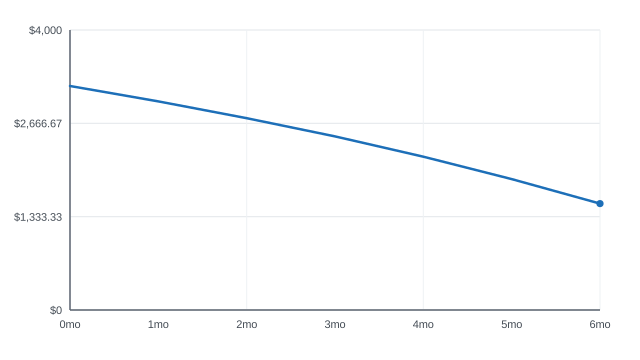
As the average daily balance falls each cycle, the interest charged in the calculation box falls with it — which is why consistent payments above the minimum create compounding savings over time.
To reproduce the calculation box from your own statement — and check whether the bank's maths is correct — use the average daily balance checker to enter your own opening balance, payment dates, and purchase dates.
Common Things Banks Don't Explain on the Statement
The grace period is not guaranteed. If you carried a balance last cycle, many issuers suspend the grace period, meaning new purchases begin accruing interest immediately from the transaction date — not from the due date (Source: CFPB, Consumer Credit Card Market Report, 2023).
The interest charge appears one cycle late. Interest assessed on a balance you have already paid off shows up on the next statement. This "trailing interest" surprises many cardholders who believed they had paid in full.
The minimum payment warning box is required by law. Since 2010, statements must include a disclosure showing how long it would take to pay off the balance making only minimum payments, and how much total interest would be paid (Source: CFPB, Regulation Z §1026.7(b)(12)). This box is often in small print at the bottom — look for it.
Cash advances appear separately. They carry a higher APR, no grace period, and a separate line in the calculation box. If you have both a purchase balance and a cash advance balance, they are managed and charged differently.
A Monthly Statement Checklist
When your statement arrives, work through these steps in order:
- Compare previous balance to last month's new balance. They should match exactly.
- Review the purchases list. Flag anything unrecognised — disputes must typically be filed within 60 days of the statement date (Source: Consumer Financial Protection Bureau, How do I dispute a charge on my credit card bill?).
- Find the interest charge calculation box. Note your average daily balance — it tells you more about your spending habits across the month than the new balance does.
- Check the APR listed. Confirm it has not changed, particularly if you missed a payment.
- Note the due date. Set a calendar reminder if you have not already done so.
- Read the minimum payment warning. The payoff timeline it discloses is based on your actual balance at the actual APR — it is worth reading every cycle.
What to Do If the Numbers Don't Add Up
Start with the interest charge calculation box. Multiply the three numbers the bank lists — average daily balance, daily periodic rate, and days in cycle — and compare the product to the interest charged line at the top of the statement. Minor rounding differences (a few pence) are normal. A larger discrepancy could indicate a billing error and is worth a call to the issuer's customer service line.
If you cannot reconstruct the average daily balance from memory — because you don't have a record of every payment and purchase date — the average daily balance checker lets you enter transactions individually to rebuild the number the bank used.
Key Takeaways
- Every statement has eight standard sections; the interest charge calculation box is the most informative and the least read.
- The average daily balance — not the closing balance — is what the bank multiplies to compute your interest charge.
- Timing of payments within the cycle changes your average daily balance and therefore your interest cost, even if the payment amount is the same.
- The minimum payment warning and the payment due date are the two most action-relevant items on the statement.
- If anything looks wrong, the calculation box gives you the numbers to verify the bank's maths yourself.