Why Paying the Minimum Is a Trap
Why Paying the Minimum Is a Trap
Making your minimum payment on time feels responsible. The due date passes, no late fee appears, and your account stays in good standing. But that sense of progress is largely an illusion — one that credit card issuers have carefully engineered over decades.
Here's what the minimum payment system is actually designed to do: keep you in debt for as long as possible while maximising the interest you pay.
How Minimum Payments Are Calculated
Credit card issuers use one of two common methods to set your minimum payment each month:
- Percentage of the balance: Typically 1% to 2% of your outstanding balance, sometimes with interest charges added on top
- Flat-fee floor: A fixed minimum — often $25 or $35 — that applies when the percentage calculation falls below that threshold
The CFPB's market reports document how these formulas play out in practice: minimums set this low keep accounts in good standing while stretching repayment out for years (Source: CFPB, Consumer Credit Card Market Report, 2023).
Because the minimum is recalculated each month as a percentage of a shrinking balance, your required payment also shrinks over time. This means you're paying less and less principal — and the debt lingers far longer than most cardholders realise.
The $3,000 Balance: A Real-World Example
Let's put concrete numbers to this.
Assume you carry a $3,000 balance on a credit card charging 22% APR — close to the current national average. The average APR on credit card accounts assessed interest stood at 22.15% as of May 2026, near the highest levels in Federal Reserve records (Federal Reserve G.19 Consumer Credit Report, 2026).
If your issuer calculates your minimum as that month's interest plus 1% of your balance (a common issuer formula, with a $25 floor), here's what the maths looks like:
- Month 1 minimum payment: approximately $85
- Portion of that payment covering interest: approximately $55
- Portion reducing your actual balance: approximately $30
That's the design. In the first month, $55 of your $85 payment — nearly two-thirds of it — vanishes as interest. Only about $30 reduces what you owe.
As your balance slowly drops, so does your minimum payment — and so does the already-tiny amount of principal being paid down. At this pace:
- Total time to pay off the balance: approximately 14 to 15 years
- Total interest paid: approximately $4,300 to $4,500 — more than the original balance itself
You borrow $3,000. You pay back roughly $7,400. That's the minimum payment trap in plain numbers.
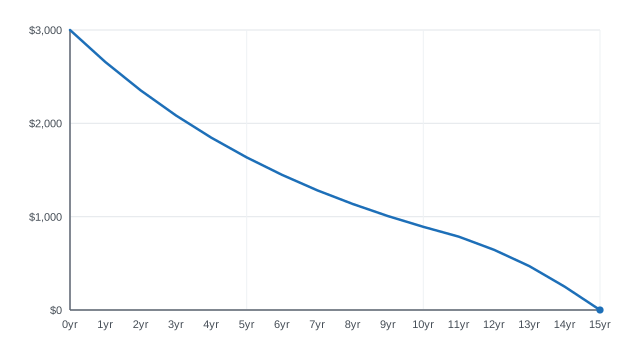
| What you see | Amount |
|---|---|
| Starting balance ($3,000 at 22% APR, minimum = interest + 1% of balance) | $3,000 |
| Month 1 minimum payment | ≈ $85 |
| — Portion covering interest | ≈ $55 |
| — Portion reducing your balance | ≈ $30 |
| Time to pay off paying only the minimum | ≈ 14–15 years |
| Total interest paid | ≈ $4,300–$4,500 |
| Total amount repaid | ≈ $7,400 |
Estimates assume a $25 minimum-payment floor, interest at APR ÷ 12 (a simplification of the daily accrual issuers actually use), and no new purchases.
If you want to see how this plays out after twelve straight months of minimums, the running tally for a full year of minimum payments puts a hard number on it.
The Psychology of "Making Progress"
The financial damage is compounded by a psychological one: minimum payments are designed to feel like enough.
Research into consumer debt behaviour finds that simply presenting a minimum payment figure anchors people to lower repayments — in one experiment with mock credit card bills, people shown a minimum payment chose to repay significantly less than those who weren't (Source: Stewart, The Cost of Anchoring on Credit-Card Minimum Repayments, Psychological Science, 2009). This is sometimes called the minimum payment anchoring effect, and it's well-documented in behavioural economics literature.
Many cardholders genuinely believe they are managing their debt responsibly by meeting minimums each month. The statement arrives, the minimum is paid, the account stays current, and the illusion of control holds — while interest quietly compounds in the background.
Federal Reserve researchers have similarly found that about 1 in 9 active credit card accounts at large banks receives only the minimum payment — a record share in recent quarters (Source: Federal Reserve Bank of Philadelphia, Large Bank Credit Card and Mortgage Data).
The Compounding Problem Nobody Warns You About
Here's what most people miss: the interest you're charged this month gets added to your principal. Next month, you're charged interest on a slightly larger number. Then again. Then again.
This is compound interest working against you — the same force that grows investments over time is quietly inflating your debt.
Total U.S. credit card balances reached $1.25 trillion in the first quarter of 2026, with a significant portion carried month-to-month by revolving borrowers (Source: Federal Reserve Bank of New York, Household Debt and Credit Report, Q1 2026). A large share of that debt is being serviced — but not meaningfully reduced — by minimum payments.
See Your Numbers With Pay Down's Minimum Payment Trap Calculator
Understanding the problem in general terms is one thing. Seeing your own numbers is another.
Pay Down's Minimum Payment Trap calculator shows you exactly what your current path looks like — no estimates, no vague warnings. Enter your balance, your APR, and your minimum payment formula, and the calculator displays:
- Your exact payoff date under minimum-payment conditions
- The total interest you'll pay if nothing changes
- How much sooner you'd be debt-free by paying even a small fixed amount above the minimum
The goal isn't to alarm you — it's to replace a vague sense of dread with a clear picture of your actual timeline. When you can see that paying an extra $50 a month cuts years off your debt, the choice becomes much easier to make.
Minimum payments aren't progress. They're a starting point. Knowing the difference is where real payoff planning begins.