The True Cost of Dining Out on Credit
The True Cost of Dining Out on Credit: What Your Restaurant Tab Really Costs
Quick answer: If you carry a balance and charge $300 a month in dining — sit-down meals, delivery apps, and takeout — at a typical 21% APR, you could pay $60 or more in interest annually on that dining spend alone, meaning every $15 lunch effectively costs closer to $18 by the time you pay it off. The exact amount depends on your balance, minimum payment behaviour, and how long you carry the debt.
How Much Are Canadians and Americans Spending on Dining Out?
Dining out is one of the top spending categories on credit cards, and the numbers are significant.
- The average U.S. household spent $3,933 on food away from home in 2023 (Source: Bureau of Labor Statistics, Consumer Expenditures in 2023, 2023).
- Cards dominate everyday purchases like dining: credit and debit cards together accounted for more than 60% of all consumer payments in 2023, with credit cards the single most-used method at 32% (Source: Federal Reserve, Diary of Consumer Payment Choice, 2023).
- The average APR on credit card accounts assessed interest stands at 22.15% as of May 2026, near multi-decade highs (Source: Federal Reserve, G.19 Consumer Credit Report, 2026).
- Almost half of cardholders — 45% — carried a balance on a credit card for at least one month in the past year (Source: LendingTree, Credit Card Debt Statistics, 2026).
When those two facts collide — frequent dining charges and a revolving balance — every meal silently becomes more expensive than the bill suggests.
Why Dining Spend Is Especially Vulnerable to Interest Creep
Restaurant spending has a few qualities that make it particularly easy to underestimate on a carried balance:
- It's frequent and diffuse. Unlike a single large purchase, dining charges accumulate across dozens of small transactions — a $12 lunch here, a $45 delivery order there. The total is rarely top-of-mind.
- Delivery apps have raised the baseline cost. The average delivery order runs about $21 — nearly 80% more than the $11.71 pickup cost for the same meal (Source: LendingTree, Delivery vs. Pickup Study, 2025). Delivery fees and service charges are themselves going on the card.
- Convenience spending resists tracking. Because restaurant charges arrive as dozens of small transactions, the category total is consistently harder to track against a budget than a single large purchase — and often surprises cardholders when the statement arrives.
The result is a spending category that can quietly become one of the largest drivers of revolving interest on a household card.
The Worked Example: $300/Month in Dining on a Carried Balance
Here's a representative scenario. Assume:
- Monthly dining charges: $300 (a mix of sit-down dinners, takeout, and delivery)
- Annual dining charges: $3,600
- Card APR: 21.59% (illustrative — close to the Federal Reserve's current 22.15% average on accounts assessed interest; Source: Federal Reserve, G.19 Consumer Credit Report, 2026)
- Assumption: These charges are added to a balance that is paid down only gradually — the cardholder makes minimum payments or slightly above, rather than paying the full statement balance each month
| Scenario | Dining Spend | APR | Effective Annual Interest on Dining | True Annual Cost |
|---|---|---|---|---|
| Pay in full monthly | $3,600 | 21.59% | $0 | $3,600 |
| 12-month payoff | $3,600 | 21.59% | ~$420 | ~$4,020 |
| 24-month payoff | $3,600 | 21.59% | ~$840 | ~$4,440 |
| Minimum payments only | $3,600 | 21.59% | $1,000+ | $4,600+ |
Interest estimates are illustrative, based on standard amortization at the stated APR. Your actual cost depends on total balance, payment amount, and billing cycle timing.
The table makes one pattern clear: the longer dining charges sit on a revolving balance, the more each meal retroactively costs. A $60 dinner for two, carried for two years, costs roughly $75 in real dollars.
Visualizing the Interest Buildup on $300/Month in Dining
The chart below shows how the cumulative true cost of $300/month in dining diverges from the face value of those meals, depending on how quickly the balance is paid down.
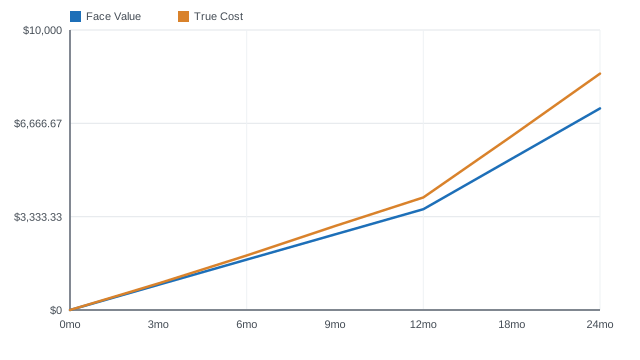
Series: Face Value | True Cost (with interest)
Breaking Down a Single Dining Occasion
It helps to think at the transaction level. Consider a common dining week:
| Occasion | Charged Amount | After 12-Month Carry (21.59% APR) | Extra Cost |
|---|---|---|---|
| Sit-down dinner (Fri) | $65 | ~$72.60 | +$7.60 |
| Delivery order (Sat) | $38 | ~$42.45 | +$4.45 |
| Work lunch (Wed) | $14 | ~$15.63 | +$1.63 |
| Weekend brunch | $42 | ~$46.91 | +$4.91 |
| Weekly total | $159 | ~$177.59 | +$18.59 |
Over a year of similar weeks, that markup adds up to roughly $960 in interest on dining alone — more than a month of additional restaurant spending at this pace, paid entirely to the card issuer rather than a restaurant.
How Does This Compare to Other Everyday Spending?
Dining is one of several everyday categories that accumulate quietly on a revolving balance. For a broader look at how the interest multiplier applies to routine purchases — groceries, gas, and other recurring spend — the interest multiplier concept behind everyday spending on credit explains the underlying math clearly.
The core mechanism is the same: any recurring charge that lands on a balance you don't pay in full generates compounding interest from the moment it posts.
Delivery Apps: A Hidden Cost Amplifier
Food delivery deserves its own note. 38% of Americans order delivery every week, and the total cost per order — including service fees, delivery fees, and tips — averages $9.30 (nearly 80%) more than the equivalent pickup (Source: LendingTree, Delivery vs. Pickup Study, 2025).
That premium is also going on the card. So the interest calculation starts from a higher base than the menu price:
- A $20 pickup order becomes roughly a $36 delivery charge at the study's average 79.5% markup.
- That $36 charged to a 21.59% APR card and carried 12 months costs roughly $40 in real terms.
- The original $20 meal has now cost about double its pickup price.
What Minimum Payments Do to a Dining-Driven Balance
The minimum payment trap hits dining spend hard, precisely because dining charges are continuous. New restaurant charges arrive every month while old ones are still being paid off.
- Making only minimum payments on a $3,600 annual dining balance at 21.59% APR would stretch the payoff timeline to more than 10 years, with total interest well over $2,000 — minimum-payment formulas are typically 1–2% of the balance or a small flat floor, whichever is greater (Source: NerdWallet, How Credit Card Issuers Calculate Minimum Payments).
- The CFPB found cardholders were charged more than $130 billion in interest and fees in 2022 alone, with a growing share of accounts making only minimum payments (Source: CFPB, Consumer Credit Card Market Report, 2023).
To see exactly how minimum payments affect your own dining balance, the minimum payment calculator can show a precise payoff timeline based on your actual balance and APR.
Frequently Asked Questions
Does charging dining to a rewards card make the interest cost worthwhile? In almost all cases, no. Most dining rewards cards return 3–4% on restaurant purchases. If the balance is carried at 21.59% APR, the interest cost vastly outweighs the rewards value. Rewards programmes are generally only net-positive for cardholders who pay in full each month.
Is it better to use a debit card for dining instead? From a pure interest-cost perspective, yes — debit removes the possibility of carrying a balance on dining charges. Whether that trade-off is right for a given person depends on their overall cash flow, budgeting approach, and card benefits. This article is educational; individual decisions should factor in personal financial circumstances.
Do delivery fees and tips count as part of the charged balance? Yes. The full amount posted to the card — including fees, taxes, and tip — accrues interest if not paid in full. The base menu price is only a fraction of what actually goes on the balance.
What's a practical way to reduce interest on dining? Common approaches include paying more than the minimum each month, allocating dining spend to a card with a lower APR, or ring-fencing dining charges to a card that is paid in full. The right approach depends on individual circumstances.
See Your Own Dining Costs
The worked examples above use representative figures. Your actual dining spend, APR, and payment habits will produce a different number — which is worth knowing precisely.
Run your real monthly dining charges through the Pay Down True Cost calculator to see what those meals are actually costing you after interest, and how much you'd save by paying the balance down faster.
This article is for educational purposes only and does not constitute financial advice. Interest calculations are illustrative estimates based on standard amortization. Actual costs vary by balance, payment history, and card terms.