The True Cost of Holiday Shopping on Credit
The True Cost of Holiday Shopping on Credit
Every December, credit card balances spike. Holiday shoppers planned to spend $831 on gifts, on average, in 2023 — and nearly three-quarters (74%) planned to put those purchases on a credit card, charging $680 on average (Source: NerdWallet, 2023 Holiday Shopping Report, 2023). A significant share of that spending didn't disappear in January: nearly a third of shoppers who took on holiday credit card debt the previous year still hadn't paid it off. It landed on a card, attracted interest, and was carried for months into the new year.
That carry period is what makes holiday debt different from everyday debt. A purchase made in late November or December often sits on a balance through spring — sometimes longer — before it's fully paid off. Understanding exactly how much that costs is the first step to planning ahead.
What Makes Holiday Spending Different From Everyday Spending?
Most credit card debt builds gradually: a coffee here, a grocery run there. Holiday debt is a lump-sum spike — gifts, flights, hotel stays, and hosting costs concentrated into four to six weeks. That concentration creates a few dynamics that everyday credit card spending doesn't:
- Large balances appear fast. A $1,200 holiday budget charged in December creates interest exposure immediately, even before the first statement closes.
- Carry duration is predictably long. Cardholders who revolve a balance and make only minimum or near-minimum payments routinely carry December charges deep into the new year.
- Repayment competes with new spending. January brings fresh expenses — utilities, insurance renewals, tax prep — that make it harder to aggressively Pay Down a holiday balance.
The average APR on U.S. credit card accounts assessed interest reached 22.15% as of May 2026 (Source: Federal Reserve, G.19 Consumer Credit Report, May 2026). At that rate, a $1,200 balance carried for seven months generates meaningful interest before it's cleared.
How Long Do Holiday Balances Actually Last?
Surveys consistently show that many consumers take months to recover from holiday spending. In a November 2024 survey, one in five Canadians and Americans (20%) said they didn't expect to financially recover from that holiday season until May of the following year or later (Source: Achieve Holiday Spending Survey, 2024). A meaningful share carry balances into late spring and beyond.
That aligns with how minimum payments work: minimums are typically set around 1% of the balance plus that month's interest and fees — or a low flat percentage — with a fixed floor of roughly $25–$35, whichever is greater (Source: CFPB, Consumer Credit Card Market Report, 2023). At those rates, a $1,200 balance at 22.15% APR takes over seven years and roughly $1,140 in interest to eliminate — if the cardholder never makes more than the minimum.
Most people pay more than the minimum, but rarely enough to close the balance quickly. A more realistic scenario might be a fixed monthly payment that retires the debt over six to nine months, still generating hundreds of dollars in interest along the way.
Worked Example: A $1,200 Holiday Balance
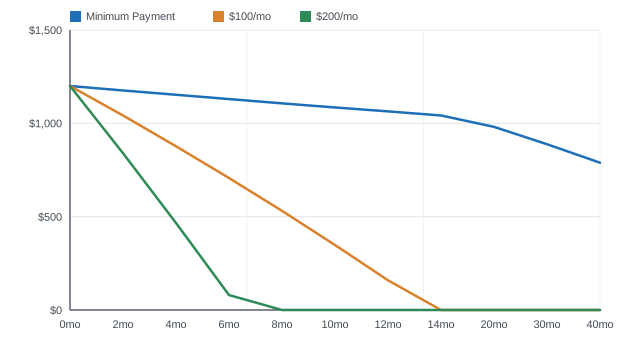
Here's how a $1,200 December holiday charge plays out at 22.15% APR under two repayment scenarios.
| Scenario | Monthly Payment | Payoff Timeline | Total Interest Paid | Total Real Cost |
|---|---|---|---|---|
| Minimum only (interest + 1% of balance, $25 floor) | Starts ~$34, decreases | ~88 months (over 7 years) | ~$1,144 | ~$2,344 |
| Fixed $100/month | $100 | ~14 months | ~$169 | ~$1,369 |
| Fixed $200/month | $200 | ~7 months | ~$84 | ~$1,284 |
Even the most disciplined realistic scenario — $200 a month — adds roughly $79 to the cost of gifts that have already been opened and used. The minimum-payment path nearly doubles the original budget.
The Hidden Costs Inside a Holiday Budget
A gift budget feels fixed — "I'm spending $1,200 this year." But that number is misleading if the balance is carried, because several costs often go unaccounted for:
- Interest on travel booked in advance. Flights or hotels charged in November start accruing interest before the trip even happens.
- Hosting and food costs. Grocery runs for holiday dinners don't feel like "debt," but if they hit a revolving balance, they attract the same APR as everything else.
- Shipping and wrapping add-ons. Small incidentals added to a carried balance each contribute to interest charges.
- Post-holiday sales. January clearance purchases added to an existing December balance extend the payoff timeline.
For a closer look at how a single larger purchase compounds over time, the analysis of what a $1,000 purchase really costs shows the same mechanics in detail.
Why Q4 Balances Carry Into Mid-Year
The seasonal timing creates a structural carry problem. Holiday charges hit in November and December. The first full statement doesn't arrive until late December or January. The minimum due on a $1,200 balance might be $25–$30. A consumer who intended to "pay it off quickly" but only made minimum or near-minimum payments in January and February can find themselves in April still carrying more than $1,000.
Meanwhile, the original purchases — gifts given, meals eaten, trips taken — have no remaining value. The spending is sunk. The interest expense is ongoing.
This is part of why average credit card balances stay stubbornly high year after year — $6,768 per borrower as of 2025 (Source: Experian Consumer Credit Review, 2025). Each December's spike doesn't have to fully resolve before the next one begins.
Strategies That Reduce the Interest Burden
No single approach eliminates carry costs entirely, but several strategies reduce them:
- Set a payoff deadline before you shop. Decide in October how many months you're willing to carry the balance, then back-calculate a monthly payment that meets that deadline.
- Separate "holiday budget" from "monthly budget." Tracking holiday spending as its own category makes it harder for it to blur into ongoing expenses.
- Make payments before the statement closes. Interest accrues daily on most cards, so reducing the average daily balance mid-cycle lowers the interest calculation for that billing period (Source: CFPB, How is credit card interest calculated?).
- Prioritise the holiday balance in January. Any end-of-year bonus, tax refund, or reduced January spending can be directed at the December balance before it compounds further.
- Avoid adding new purchases to the balance. Charging January expenses to the same card that holds the holiday balance extends the payoff timeline automatically.
How to Project Your Own Holiday Interest Cost
The total interest you'll pay depends on three variables: the balance, your APR, and how quickly you Pay Down. Small changes in any of these have an outsized effect — a $150/month payment versus a $100/month payment can cut total interest by a third or more.
Before this year's holiday season, run your anticipated spend through the True Cost calculator to see exactly what your gift budget will cost at your card's actual APR over a realistic repayment timeline. Seeing the number in advance is one of the clearest ways to set a realistic budget — or reconsider how much to charge.
Key Takeaways
- Holiday shoppers spend over $800 on gifts on average — most of it charged to credit cards — and nearly a third of those who take on holiday debt are still paying it off well into the following year (Source: NerdWallet, 2023 Holiday Shopping Report, 2023).
- At 22.15% APR, a $1,200 balance paid off over 14 months at $100/month costs roughly $169 in interest — money spent on purchases that have already been consumed (Source: Federal Reserve, G.19 Consumer Credit Report, May 2026).
- Minimum payments on holiday balances can extend repayment to seven or more years and nearly double the original spend.
- The Q4 timing of holiday purchases means balances carry structurally into mid-year, competing with new expenses and often rolling into the next holiday season.
- Projecting interest costs before shopping — not after — is the most effective way to keep a holiday budget accurate.