The True Cost of Everyday Spending on a Credit Card
What Is the True Cost of an Everyday Purchase?
The sticker price of anything you buy on a credit card is not necessarily what you pay for it.
When you pay your balance in full each month, the price and the true cost are the same — no interest accrues, and the card is simply a payment tool. But when you carry a balance from one statement to the next, interest accumulates on every dollar you have not repaid. That interest is the gap between the price tag and what the purchase actually costs you.
True cost = purchase price + interest allocated to that purchase over the months it is carried.
This relationship is simple in principle, but its effects compound quickly across an entire month of everyday spending — groceries, gas, coffee, subscriptions, dining out. Each of those purchases, unremarkable on its own, earns a hidden markup the moment it is rolled into a carried balance.
Why Does Carrying a Balance Change the Price You Actually Pay?
The average interest rate on credit card accounts assessed interest in the United States reached 22.15% APR as of May 2026 (Source: Federal Reserve Board, Consumer Credit - G.19, May 2026). At that rate, a balance that is not paid off generates substantial interest charges over even a few months.
What makes the math especially consequential is how issuers calculate interest. Card issuers charge a daily periodic rate — your APR divided by 365 — applied each day to your average daily balance for the billing cycle. That means interest is not a single charge applied once a month; it accrues every single day the balance remains unpaid.
And many Canadians and Americans do carry balances. Roughly 47% of American credit cardholders currently carry a balance (Source: Bankrate, 2026 Credit Card Debt Report, 2026). The average credit card balance per consumer is approximately $6,730 (Source: Experian, Q3 2024).
At 22.15% APR, a $6,730 balance generates roughly $1,491 in annual interest — about $124 a month — before a single new purchase is added.
How the Carried-Balance Multiplier Works (A Worked Example)
To understand the multiplier, start with one purchase: a $200 grocery run charged to a card carrying an ongoing balance at an illustrative 21.76% APR — close to recent national averages, and the rate the charts on this page are drawn at. Assume the $200 is repaid over 12 months — either as new spending that keeps the balance elevated, or as a portion you slowly pay down.
The daily periodic rate is 21.76% ÷ 365 = 0.05962% per day.
Over 12 months, that $200 accrues approximately $23.55 in interest, making the true cost $223.55 — a multiplier of roughly 1.12×.
That might sound modest for one grocery trip. But apply the same multiplier across an entire month of everyday spending:
| Category | Purchase Price | Interest (12 mo) | True Cost |
|---|---|---|---|
| Groceries | $200 | $23.55 | $223.55 |
| Gas | $80 | $9.42 | $89.42 |
| Streaming subscriptions | $45 | $5.30 | $50.30 |
| Coffee / cafés | $60 | $7.07 | $67.07 |
| Dining out | $120 | $14.13 | $134.13 |
| Monthly total | $505 | $59.47 | $564.47 |
One month of routine spending — $505 at face value — becomes nearly $565 when carried for a year. Annualise that pattern and the interest load on just those five categories approaches $713.
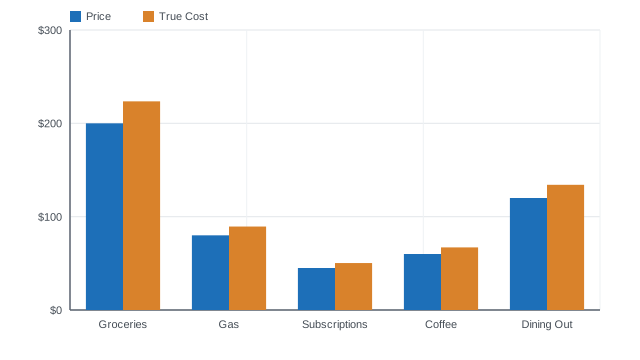
The multiplier itself — in this case 1.12× at 21.76% APR over 12 months — is not fixed. It rises with a higher APR, a longer repayment period, or both. A purchase carried for 24 months instead of 12 at the same rate produces a multiplier closer to 1.25×.
Everyday Spending, by Category
The multiplier plays out differently depending on what you buy and how often. Each category below has its own rhythm — daily habits are different from annual blowouts, and recurring charges behave differently from one-time emergencies. The articles linked here quantify those differences with their own worked examples; this hub owns the model, and they own the numbers.
Daily habits and small purchases. The math on frequent small charges is counterintuitive — frequency matters as much as amount. See how daily habit spending adds up on a carried balance over months and years.
Coffee and café spending. A daily coffee seems harmless, but as a recurring charge on a revolving balance it earns interest every day it goes unpaid. Find out what a regular coffee habit actually costs when interest is factored in.
Dining out. Restaurant spending tends to cluster on weekends and social occasions — irregular but frequent. Explore how dining-out charges on a carried balance accumulate into a meaningful annual cost.
Holiday and seasonal shopping. A single concentrated spending period that is not paid off before interest kicks in can inflate costs well into the following year. See how holiday spending carried on a credit card stretches its price tag long after the season ends.
Subscriptions and recurring charges. Subscriptions are quietly persistent — they charge every month whether or not you pay attention, and each cycle compounds the balance. Read about the true cost of recurring subscriptions on an unpaid balance.
Larger one-time purchases. A single $1,000 charge is easier to isolate and model than a pattern of small ones — which makes it a useful anchor for understanding the multiplier at scale. See what a $1,000 purchase really costs when carried over time.
Unexpected expenses. Emergency spending — a car repair, a medical bill — often lands on a card precisely when cash flow is tight, meaning it tends to be carried the longest. Understand how an emergency car repair on a credit card grows in real cost while the balance lingers.
How to Find Your Own True-Cost Multiplier
The worked example above uses 21.76% APR, but your card's rate may be higher or lower, and your repayment timeline may differ. Both variables shift the multiplier significantly.
The general formula:
True Cost = P × (1 + (APR ÷ 365) × days carried)
Where P is the purchase price, APR is your card's annual percentage rate as a decimal (e.g., 0.2176), and days carried is how long the purchase remains in your balance.
This formula is the full-carry worst case — it assumes the entire purchase stays on your balance untouched for the whole period, which is also the model the line chart below uses. If you pay a purchase down steadily instead, the interest works out to roughly half that, which is the model the category table above uses (that is why $200 over 12 months accrues about $24, not $44).
A few reference points at common APRs, assuming steady paydown over 12 months:
| APR | Multiplier (12 mo) | $100 purchase true cost |
|---|---|---|
| 15% | 1.08× | $108 |
| 20% | 1.11× | $111 |
| 24% | 1.13× | $113 |
| 29% | 1.16× | $116 |
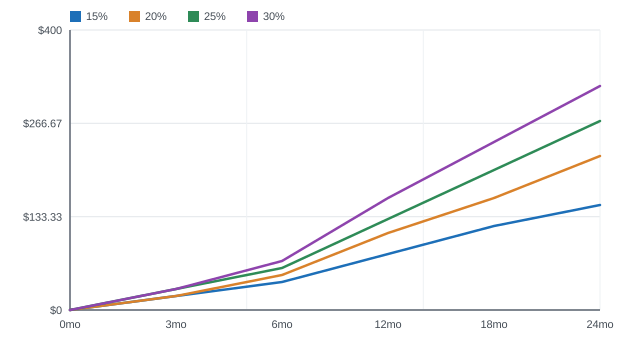
The APR on your card is listed on your monthly statement and in your cardmember agreement. If you are unsure what rate applies to your purchases, that is the first number to find.
To apply this to your own spending — your balance, your APR, your mix of purchases — use Pay Down's true cost calculator to see exactly how much any purchase is costing you above its sticker price.
For a firsthand look at this pattern over time, see what six months of tracking every purchase's true cost revealed.
The One Variable That Erases the Gap
There is a straightforward way to bring the multiplier back to 1.0×: pay the balance in full before interest accrues. Cardholders who pay in full each cycle pay no interest, and the true cost of every purchase equals its sticker price exactly (Source: CFPB, What is a grace period?).
That is the core insight this framework is built on. The gap between price and true cost is not a fixed feature of credit card spending — it is a direct function of whether you carry a balance. Understanding that relationship, and where it appears in your own everyday spending, is the first step to closing it.