Why You Were Charged Interest After Paying Off Your Credit Card
The Short Answer: It's Called Trailing Interest
If you paid your credit card in full and still received an interest charge on your next statement, you were billed trailing interest — sometimes called residual interest. It is not an error.
Here is what happened: interest on a credit card accrues every single day. Your statement balance was a snapshot of what you owed at the moment the billing cycle closed. Between that closing date and the day your payment actually posted to the account, the remaining balance kept accruing interest at the daily rate. That small charge had not yet been billed when your statement printed, so it showed up one statement later.
Why Does the Balance Keep Accruing After the Statement Closes?
When you carry a balance from month to month, you lose your grace period. The grace period is the window — typically 21 to 25 days — during which new purchases are not charged interest before the due date. Once a balance carries over, that protection disappears, and how that grace period works becomes important to understand.
Without a grace period in effect, your balance accrues interest daily from the moment you are billed — and continues accruing until your payment clears. The formula is straightforward (and explained in detail in this overview of how credit card interest is actually calculated):
Daily interest = (APR ÷ 365) × average daily balance
Your statement is not a live metre; it is a closing snapshot. Any interest that built up after the cycle closed goes on the next statement.
A Worked Example
Suppose your statement closes showing a $3,000 balance at 24% APR. You pay the full $3,000 — but the payment posts 18 days after the closing date.
During those 18 days, interest was accruing daily:
| Detail | Value |
|---|---|
| Statement balance | $3,000 |
| APR | 24% |
| Daily rate (APR ÷ 365) | ≈ 0.06575% |
| Days between close and payment posting | 18 |
| Approximate trailing interest | ≈ $35 |
Math: $3,000 × (0.24 ÷ 365) × 18 ≈ $35.51
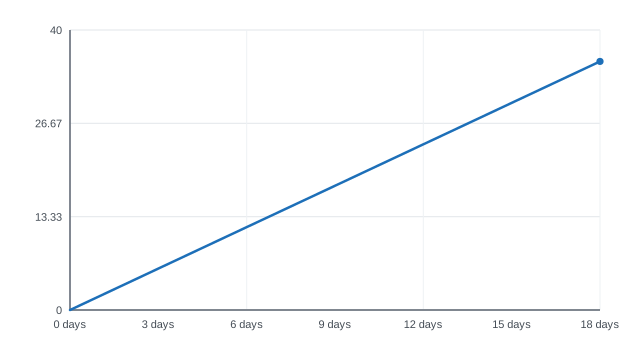
This is an approximation — the exact figure depends on the precise daily balances during those 18 days, not just the closing balance. But it illustrates why a seemingly paid-off card generates another charge.
Want to see how much interest your own balance is accumulating day by day? The Pay Down average daily balance calculator lets you plug in your real balance and APR to estimate the daily accrual.
What Should You Do Now?
Pay the Trailing-Interest Statement in Full
The most direct fix is simply to pay the trailing-interest charge in full when it appears. One additional full payment is usually enough to clear the account completely — as long as you have not made new purchases that carried over again.
Ask for a Payoff Amount Quoted to a Specific Date
Many issuers will provide a payoff amount — the exact dollar figure needed to bring the balance to zero — calculated through a specific future date. This accounts for interest that will continue to accrue until that date, so the payment eliminates the balance entirely rather than leaving a small residual. Call the number on the back of your card and ask for "a payoff quote" or "payoff amount good through [date]."
Ask the Issuer to Waive It
Some issuers will waive small residual interest charges, particularly for customers who have a good payment history. Practices differ by bank and are not guaranteed, but it is a reasonable question to ask when you call. Frame it simply: you paid the full statement balance and did not realise interest would continue to accrue after the closing date.
How to Prevent This in the Future
Once you have cleared the trailing interest, the goal is to restore your grace period so that future purchases are not automatically charged interest. That typically requires paying the full statement balance for one or two consecutive billing cycles — but the specifics depend on your card's terms.
Quick Reference: Trailing Interest at a Glance
- What it is: Interest that accrued between your statement closing date and the date your payment posted
- Why it happens: Without a grace period, balances accrue interest daily with no pause between statement close and payment receipt
- When it appears: On the next statement after your payoff
- How much: Depends on your APR, your daily balance, and how many days elapsed before the payment posted — often a small amount but sometimes more
- How to fix it: Pay the charge in full; or call ahead and request a date-specific payoff amount so your payment covers every dollar of accrued interest
Key Takeaways
- Trailing interest is not a billing error — it is interest that accrued daily after your statement closed and before your payment posted.
- The daily rate is APR ÷ 365, applied to the balance outstanding each day; it never pauses between billing cycles when a balance is carried.
- Paying the trailing-interest charge in full typically ends the cycle; requesting a payoff amount quoted to a future date is the most precise way to zero out a balance completely.
- Some issuers will waive small residual interest charges upon request — it is worth asking, though outcomes vary.
Let Pay Down watch this for you
The free Pay Down app shows which of your cards are interest-free right now and can remind you before a grace period ends — anchored to your card's actual statement dates, not a guess. Premium adds bank auto-sync through Plaid and the Insights tab's full grace-state view for every card — intact, at-risk, or lost. Pay Down is free on the App Store and Google Play.