The Hidden Cost of Credit Card Rewards Programs
The Rewards-Card Paradox: What the Points Don't Cover
Rewards credit cards are marketed on what you earn — cash back, airline miles, points redeemable for travel or merchandise. But there is a number that cancels out most of those benefits almost as soon as a balance goes unpaid: the card's APR.
The average APR on U.S. credit card accounts assessed interest stood at 22.15% as of May 2026 (Source: Federal Reserve, Consumer Credit G.19, May 2026). The average cash-back reward rate sits between 1% and 2% for most cards, with premium cards reaching 5% in select categories (Source: WalletHub, Credit Card Landscape Report, 2026). The arithmetic gap between those two figures is where rewards programs quietly lose their value.
How Quickly Does Interest Erase Rewards?
The short answer: on a typical rewards card, one month of carrying a balance at average APR wipes out most — and often all — of the rewards earned on that balance.
Here is the core equation:
- Monthly interest cost = Balance × (APR ÷ 12)
- Monthly rewards earned = Spending × Rewards rate
These are simplified monthly approximations — in practice, issuers accrue interest daily, applying APR ÷ 365 to your average daily balance, which comes out slightly higher than the monthly shortcut.
At 22.15% APR, a carried balance of $1,000 accrues roughly $18.46 in interest in a single month. A 2% cash-back card earning rewards on that same $1,000 in spending generates $20.00. That looks close to break-even — but it is not, because interest compounds on the full unpaid balance while rewards are earned only on new purchases, not on the balance itself.
The moment a cardholder stops paying in full, last month's unredeemed rewards begin accruing interest charges. The reward is earned once; the interest cost repeats every billing cycle.
Worked Example: $2,000 Balance, 2% Cash Back
Suppose a cardholder spends $500 per month on a card with:
- Rewards rate: 2% cash back
- APR: 22% (close to today's national average)
- Carried balance: $2,000 (not paid off each month)
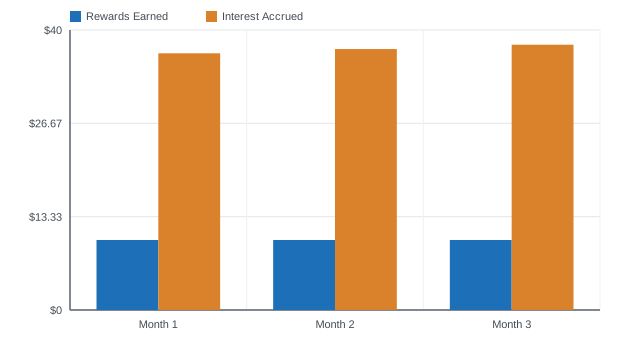
| Month | Rewards Earned on $500 Spend | Interest Accrued on $2000 Balance | Net (Rewards − Interest) |
|---|---|---|---|
| 1 | $10.00 | $36.67 | −$26.67 |
| 2 | $10.00 | $37.28 | −$27.28 |
| 3 | $10.00 | $37.90 | −$27.90 |
| 3-Month Total | $30.00 | $111.85 | −$81.85 |
After three months, the cardholder has earned $30 in rewards and paid $111.85 in interest — a net loss of $81.85. The rewards offset less than 27 cents of every dollar of interest charged.
What About Premium Cards With Higher Reward Rates?
Premium travel cards can offer 3%–5% on certain categories and sign-up bonuses worth hundreds of dollars. Do those change the maths?
For sign-up bonuses, yes — temporarily. A $200 sign-up bonus creates a buffer that may take several months of interest charges to erode. But once that buffer is spent, the ongoing reward rate faces the same unfavourable comparison.
On a 5% category card:
- $500 of category spending earns $25.00 in rewards
- $2,000 carried balance at 22% APR costs $36.67 in interest
The monthly shortfall is still −$11.67, even at the highest common reward rate. The only scenario where rewards reliably exceed interest is a balance paid in full every month — in which case there is no interest charge at all.
The Break-Even Carried Balance: It Is Smaller Than Most People Expect
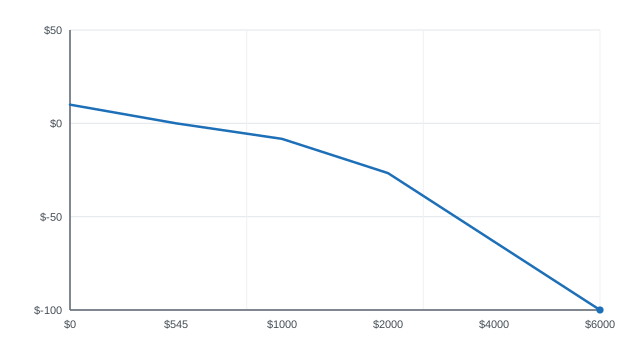
The break-even point — where monthly interest cost equals monthly rewards earned — can be expressed as:
Break-even balance = (Rewards rate × Monthly spend) ÷ (APR ÷ 12)
For 2% rewards on $500/month spend at 22% APR:
Break-even balance = ($10.00) ÷ (0.01833) = $545
A carried balance above $545 means interest charges exceed rewards earned that month. Most cardholders carrying a balance hold significantly more than that — the average consumer carrying a balance owes over $6,000 in credit card debt (Source: Experian, State of Credit Cards, 2024).
At $6,000 carried:
- Monthly interest at 22% APR: $110.00
- Monthly rewards at 2% on $500 spend: $10.00
- Net monthly loss: −$100.00
For a deeper look at how that interest figure is actually constructed before it appears on your statement, how APR translates into what you actually pay is worth reading.
Why This Matters: The Psychology of Rewards
Rewards programs are designed to encourage spending. Research by Federal Reserve economists found that reward cards induce more spending, leaving consumers who carry balances with higher unpaid debt — and therefore higher interest costs — over time (Source: Federal Reserve Board, Who Pays For Your Rewards?, 2023). The reward itself can become the mechanism by which the balance grows.
This effect is explored in detail in one cardholder's account of tracking the real price of every purchase for six months, where the gap between the posted price and total cost became visible only after interest was counted.
The pattern is not unique to rewards cards — it is the same dynamic described in the broader case for understanding what carrying a balance actually costs, but with an added layer: the rewards framing can make a card feel profitable when it is running at a net loss.
What a Positive Net Return Actually Requires
For rewards to produce a genuine positive return, two conditions generally need to be true simultaneously:
- The balance is paid in full each month — eliminating interest charges entirely
- The card's rewards rate exceeds any annual fee cost, calculated as a percentage of annual spend
If either condition fails, the financial maths typically shifts against the cardholder. A $95 annual fee requires roughly $4,750 in annual spending at 2% cash back just to break even on the fee alone — before accounting for any interest.
Seeing Your Own Numbers
The worked examples above use round figures. Your actual card may have a different APR, a tiered rewards structure, or a mix of categories. To see what a specific purchase really costs once interest is allocated to it — and whether rewards come close to offsetting that cost — you can model your own balance and spending with the purchase true cost calculator.
The calculation will not change the underlying dynamic, but it does make the tradeoff visible in concrete dollar terms rather than percentages.
Key Takeaways
- The average credit card APR on interest-assessed accounts (22.15%) exceeds the highest common rewards rate (5%) by more than 4 to 1 (Source: Federal Reserve, Consumer Credit G.19, May 2026)
- A 2% cash-back card reaches interest-exceeds-rewards territory at a carried balance of roughly $545, assuming $500/month in new spending at 22% APR
- Premium rewards and sign-up bonuses can create a temporary buffer but do not change the long-run maths for cardholders who carry a balance
- Rewards cards produce a positive net return reliably only when the full balance is paid each billing cycle